Nurturing the Struggling Learner: A Reflection from a Teacher, Coach, and Mother
My youngest son is about to head on to secondary school—and as a teacher and mom, I find myself watching him with familiar worry. Despite my years in the classroom and a deeper understanding of learning than I had as a young parent, part of me still aches when I see him struggle. Because I know that struggle intimately.
Growing up, school didn’t come easily to me. I wasn’t the “fast finisher,” the “natural reader,” or the kid who loved math centers. I was the student who tried twice as hard just to stay afloat. The one pulled into quiet tutoring rooms. The one who lined up for timed math facts with a sinking feeling in my chest. And no matter how hard I worked, I often felt like it just wasn’t enough.
But what made the difference—what truly changed everything—were a few incredible teachers. Not because they made things easier, but because they made me feel seen. They replaced fear with curiosity. Frustration with possibility. And most of all, they made me believe I was capable.
Now, as both a parent and instructional coach, I carry those memories into every classroom I support. I want your students—and my son—to be surrounded by educators who nurture, challenge, and celebrate their way of learning.
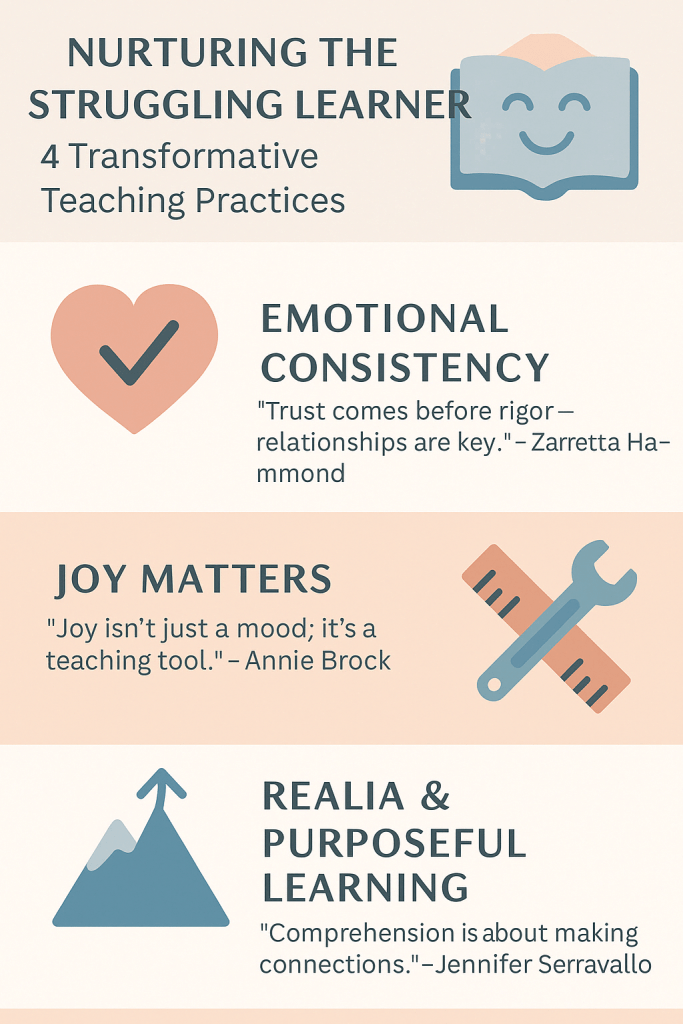
If you’re a teacher or a parent looking for ways to empower learners who struggle, here are four approaches that changed everything for me—and still hold power today.

1. Emotional Consistency: Trust Is Built in the Quiet Moments
Students—especially those who struggle—need predictable, emotionally safe environments. When a child isn’t sure which version of a teacher will show up, they brace themselves instead of opening up to learn.
“Relationships are the foundation of culturally responsive teaching. Trust comes before rigor.” — Zaretta Hammond
Use positive framing to shift your language. Instead of “Don’t run,” say “Use your walking feet.” Instead of “You’re not listening,” try “Let’s refocus so we can move forward together.” This subtle change invites cooperation instead of demanding it.
Balance praise and redirection intentionally. I’ve always remembered Doug Lemov’s 3:1 ratio—three praise statements for every correction. When students feel safe to take risks and are praised for effort, even the struggling learner becomes the resilient learner.
2. Joy Matters: Lead with the J-Factor
Students can feel your energy before you say a word. When joy walks into the room before the lesson even begins, it becomes contagious.

“Joy isn’t just a mood; it’s a teaching tool.” — Annie Brock, The Growth Mindset Coach
Be passionate. Be silly. Read books aloud with wild voices. Celebrate vocabulary words. Let students teach you something. Normalize fun and laughter, because those are the moments students remember—and the moments that anchor them to your classroom.
I became a reader because of one joyful teacher. He didn’t just teach books—he lived them. He taught me that literature could be layered, meaningful, personal. And now, I teach and coach with that same belief.
3. Realia & Purposeful Learning: Learning Must Be Felt, Not Just Taught
Struggling learners often lack background knowledge—not ability. Realia (real-world objects, media, artifacts, visuals, food, or people) builds schema. When students touch it, see it, taste it, or connect it to their lives, it sticks.

“Comprehension is about making connections. If the foundation isn’t there, build it first.” — Jennifer Serravallo
And don’t stop with the lesson. Let students apply their learning in real, expressive ways:
- Skits
- Art
- Projects
- Presentations
- Student-created videos or podcasts
These entry points offer learners multiple ways to show understanding, and allow students to shine beyond paper-pencil tasks.
One of my best school memories? A mock trial in middle school where I wrote a closing argument with my mom. For once, I was the star. And that mattered more than any grade ever could.
4. Normalize the Struggle: Make Mistakes a Safe Place to Land
“Getting it wrong and then getting it right is one of the fundamental processes of schooling.” — Doug Lemov

The power of “yet” is real. But students don’t believe in it until we show them it’s safe to fail.
Post anchor charts that highlight common mistakes. Create error analysis stations. Reflect publicly on your own missteps. And most of all, praise students not just for right answers—but for thoughtful attempts.
I had two teachers who championed my effort more than my outcome. Their belief pushed me into spaces I never thought I belonged—auditions, solos, leadership. They saw something in me that I hadn’t yet seen in myself.
Let’s do the same for our students.
A Final Word

When I became a teacher, my goal was never perfection—it was presence. I wanted my classroom to be a place where students felt seen, supported, and celebrated. A place where struggle wasn’t shameful. A place where kids could be brave.
I’m not sure I always got it right—but I hope my students knew they mattered.
If you’re reading this—teacher, parent, coach—remember: you have the power to change the narrative for a child who’s struggling. It doesn’t take a fancy program or perfect lesson. It just takes you, consistently showing up with compassion, joy, and a willingness to keep learning right alongside them.
Let’s make school a place where every child feels safe to struggle, to grow, and to believe they belong.
 Bloom with Aubrey