A Simple Strategy That Helps Struggling Readers Read with Purpose
Struggling readers don’t usually struggle because they can’t read.
They struggle because they don’t know how to enter text with confidence.
When students are handed an essay or article and told to “start reading,” many immediately fall into survival mode. They skim randomly, fixate on unfamiliar words, or disengage altogether. For them, reading feels like guessing—because it is.
That’s where Close the GAPS changes everything.
Why Struggling Readers Need a Way In
Douglas Fisher and Nancy Frey remind us that “students need clarity about what they are reading and why they are reading it before they can engage deeply.” When readers don’t understand the purpose or structure of a text, comprehension becomes accidental instead of intentional.
Struggling readers often:
- Don’t recognize genre
- Don’t know what the author is trying to do
- Don’t know whose voice they’re reading
- Don’t know how the text is organized
So they guess. And on multiple-choice questions, guessing looks like confusion.
What It Means to “Close the GAPS”
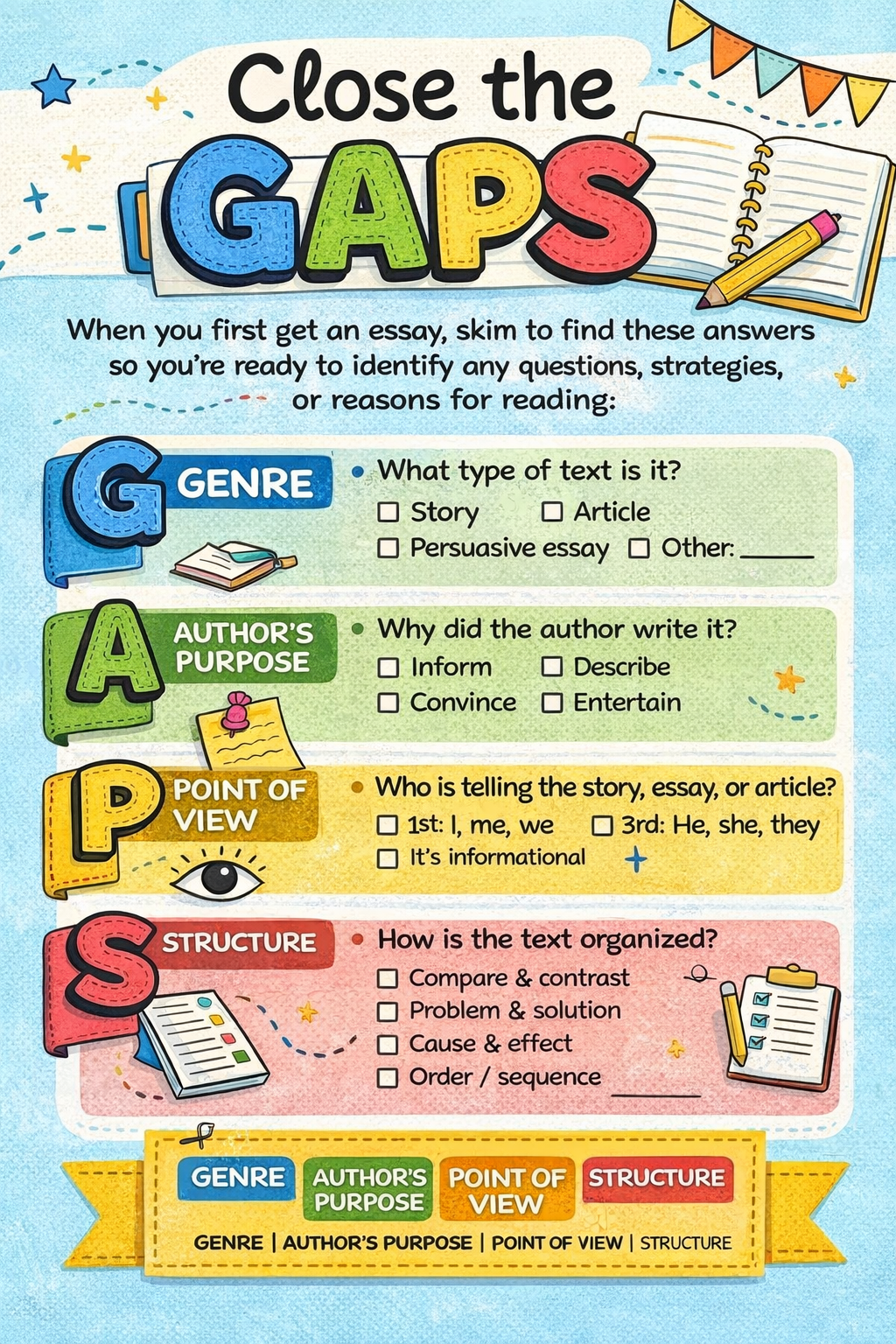
Close the GAPS is a pre-reading strategy that students use the moment they receive a text. Before reading closely, they skim to identify:
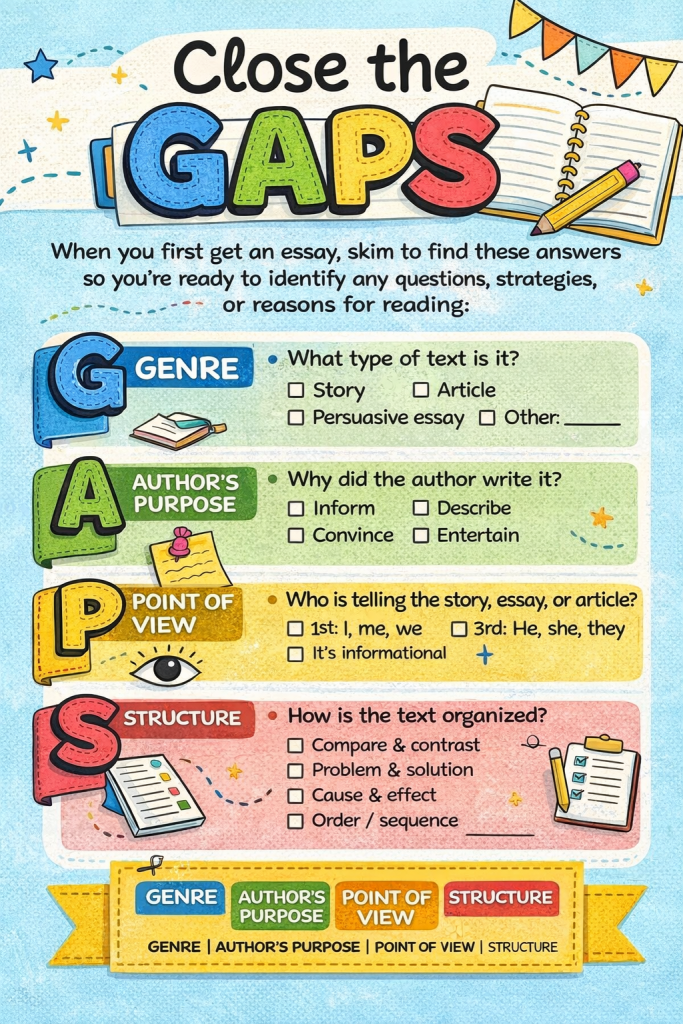
- G – Genre: What type of text is this?
- A – Author’s Purpose: Why was it written?
- P – Point of View: Who is speaking or presenting information?
- S – Structure: How is the text organized?
This is not busywork.
This is orientation.
When students identify GAPS first, they are no longer reading blindly—they are reading with a plan.
Why This Matters for Comprehension (and Confidence)
Timothy Shanahan emphasizes that comprehension improves when students understand how texts are built, not just what they say. Structure and purpose act like road signs for the reader.
When students close the GAPS:
- They anticipate the kinds of questions that may be asked
- They know where to look for answers
- They can eliminate distractors more efficiently
- They understand that multiple answers may seem right—but only one fits the text’s purpose
This is especially powerful for struggling readers, who often feel overwhelmed by answer choices that all “sound good.”
Close the GAPS Turns Guessing Into Strategy
Nell Duke’s research on informational text highlights that students comprehend better when they know what kind of reading they are doing. An argumentative text requires different thinking than a narrative or explanatory one.
When students know:
- “This is argumentative,” they expect claims and evidence
- “This is cause and effect,” they track relationships
- “This is third-person informational,” they stop searching for opinions
Suddenly, the text feels predictable—and predictability reduces anxiety.
Why This Strategy Helps Close Achievement Gaps
Struggling readers often have fewer academic reading experiences, not fewer abilities. Close the GAPS levels the playing field by making expert reader thinking visible.
Instead of asking:
“Why didn’t they get it?”
We start asking:
“Did we give them a way into the text?”
As Fisher and Frey note, when strategies are explicit and repeatable, students begin to internalize them. Close the GAPS is repeatable, quick, and transferable across content areas.
That’s how gaps close—not through more reading, but through better entry points.
What This Looks Like in the Classroom
Teachers introduce Close the GAPS as:
- A 1–2 minute skim routine
- An anchor chart students reference daily
- A shared language across grade levels and content areas
Students learn to say:
- “This is informational, so I shouldn’t expect opinions.”
- “This structure is problem–solution, so the answer must include both.”
- “The author’s purpose helps me eliminate this choice.”
That metacognition is the win.
Final Thought
Struggling readers don’t need harder texts or longer lessons.
They need clarity.
Close the GAPS gives students a way to orient themselves, make sense of multiple answers, and read with intention instead of fear.
When students know what they’re reading, why they’re reading it, and how it’s built, comprehension stops being a mystery—and starts becoming a skill.
Practice available on the TPT page – Bloom with Aubrey here https://www.teacherspayteachers.com/Product/Reading-Comprehension-Strategy-Closing-the-GAPS-15090369
 Bloom with Aubrey
Leave a comment