“Write a multiparagraph essay explaining how butterflies represent personal growth. Be sure to include a controlling idea, three examples from the text, and an awkward transition sentence that begins with ‘Another example is…’”
Ah yes. Nothing says “future-ready writer” like robotic sentence stems and vague thematic claims about butterflies.
Now, don’t get me wrong. State tests exist, and we all know they’re not going anywhere (unless we win the educational lottery and someone accidentally deletes them from the state server forever). But while we prep for the test, we also need to prepare students for life beyond the multiple-choice matrix and pixel-perfect rubrics.
Because newsflash: our students aren’t standardized, and their writing shouldn’t be either.
As Kelly Gallagher once said:
“If students are only writing for the teacher, we are robbing them of the real power of writing.”
And by “real power,” he means the kind that gets you hired, heard, or published—not just bubbled into a box.
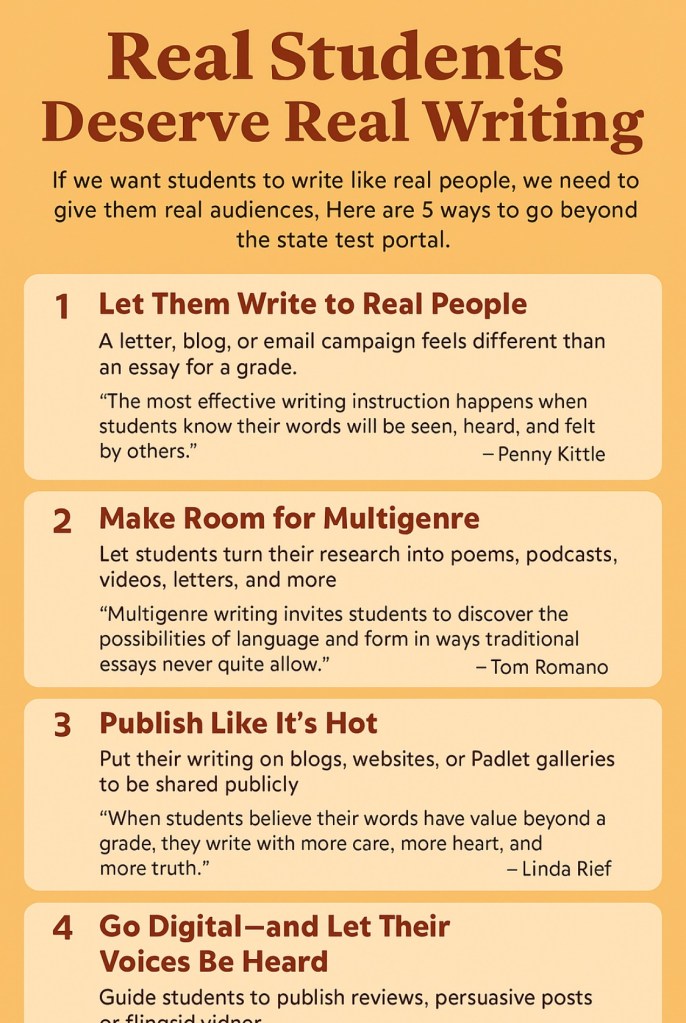
So how do we balance test prep with writing that actually prepares students for the real world? Here are five ways to make writing feel less like a worksheet and more like a window into the world:
1. Let Them Write to Real People (No offense to you, Teacher.)
Letters to the school board. Advice blogs for incoming 6th graders. Email campaigns to local leaders. When students write to someone besides you, it shifts everything.
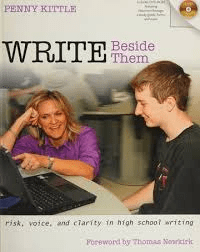
“The most effective writing instruction happens when students know their words will be seen, heard, and felt by others.” — Penny Kittle, Write Beside Them
Real audience = real effort. Also, they proofread more when someone other than you is reading (go figure).
2. Make Room for Multigenre (A Test Prompt Would Never…)
Let students turn their research into a podcast script, a social media thread, a spoken word poem, or a visual letter. Enter: Tom Romano, the multigenre guru.
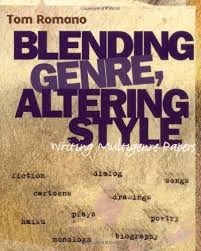
“Multigenre writing invites students to discover the possibilities of language and form in ways traditional essays never quite allow.” — Tom Romano, Blending Genre, Altering Style
Because let’s be honest: in the real world, no one’s asking them to write a five-paragraph essay about the moon’s symbolism in Hatchet. But they might need to write a grant application, an Instagram caption, or a campaign speech someday.
3. Publish Like It’s Hot
Use Google Sites, Flip videos, Padlet galleries, or student blogs. Host a digital gallery walk. Let their words go live.
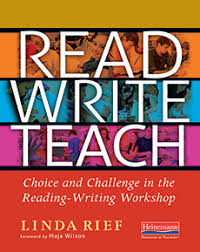
“When students believe their words have value beyond a grade, they write with more care, more heart, and more truth.” — Linda Rief, Read Write Teach
4. Go Digital—and Let Their Voices Be Heard
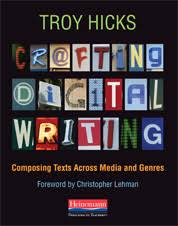
According to Troy Hicks:
“If we want students to write well in the 21st century, we need to teach them how to write for digital spaces where their work can live and breathe.” — Troy Hicks, Crafting Digital Writing
Give them a platform. Let them write reviews, record podcasts, or write persuasive posts. They’re already content creators—we just need to teach them how to do it with craft, clarity, and purpose.
5. Write What Matters (Even if It’s Not Test-Aligned)
Have you ever seen a student light up over a standardized prompt? Exactly.
But give them the chance to write about their neighborhood, their grandmother’s tamales, or what it feels like to be them in this moment—and suddenly, their voice shows up like a guest star on opening night.
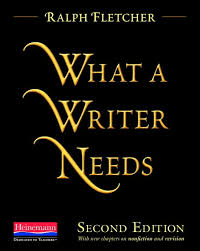
“When students write in a personal voice, when they write what they care about, their writing begins to matter—to them, and to others.” — Ralph Fletcher, What a Writer Needs
You don’t have to choose between writing from the heart and writing for the test. You can do both. Just don’t let the test be the only writing that matters.
In Conclusion: Stop Pretending the Rubric is the Real World
Nancie Atwell reminds us:
“Writing is thinking. It is the way we come to know ourselves and our world.” — In the Middle
So yes—give them structure, give them models, and give them strategies. But also, give them a reason to write beyond points and paragraphs.
Because standardized writing might get them a score. But authentic writing? That’s what gets them heard.
 Bloom with Aubrey
Leave a comment